A Bangladeshi wedding is not one event. It is a week of them. Gaye holud in an open courtyard at 4pm with sunlight bouncing off yellow marigold. Mehendi indoors under warm tungsten. Akhd in a mosque or a community centre where flash is discouraged and the ceiling fans are the loudest thing in the room. Then the reception, usually a convention hall in Dhaka or Chattogram, lit by whatever the decorator felt like installing that season.
Your lens has to survive all of it. And it has to do it while you are walking backwards through a crowd of two hundred relatives who all have their phones up.
This guide covers which Sigma lens for wedding photography actually earns its place in a Bangladeshi kit, why, and in what order you should buy them. No brochure copy. Just what works on the day.
Why Sigma has become the default for wedding shooters here
Ten years ago, buying third-party glass for paid work felt like a compromise. That argument is over. Sigma’s DG DN line was designed from scratch for mirrorless mounts rather than adapted from DSLR designs, and the autofocus motors in the current generation keep up with eye-detect on Sony and L-mount bodies without the hunting that used to embarrass people at receptions.
The practical reason most Bangladeshi photographers land on Sigma is simpler though. A working wedding kit needs at least three fast lenses. Buying three first-party f/1.4 primes costs roughly what a decent second body plus three Sigma primes costs. That second body matters more than the badge on the barrel, because when a lens fails mid-ceremony you cannot ask the bride to wait.
Availability matters too. Getting a lens serviced locally rather than shipping it abroad is worth real money when your calendar is booked through the season.
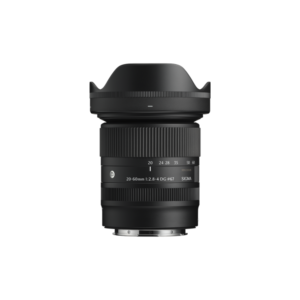
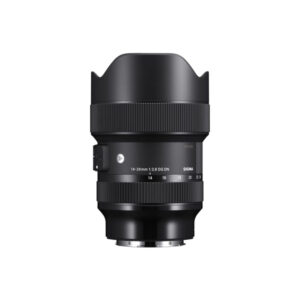
The lens that does the most work: Sigma 24-70mm F2.8 DG DN II Art
If you can only buy one lens, buy this one. It is not the most exciting choice. It is the correct one.
Wedding coverage is mostly a range problem. You need 24mm for the full stage during the ring exchange, 35mm for group shots of the bride with her cousins, 50mm for candids at the table, and 70mm for a tight frame of the mother crying. A prime forces you to walk. At a Bangladeshi wedding, there is often nowhere to walk to.
The second-generation 24-70mm fixed the two complaints people had about the original. It is noticeably lighter, which matters at hour nine, and the autofocus is now linear motor driven rather than stepping motor, so it tracks a moving subject instead of confirming focus after the moment has passed.
Use it for: ceremony coverage, stage shots, group formals, anything where you cannot control your position.
Its weakness: f/2.8 is not fast. In a dim akhd room you will be at ISO 6400 and wishing for a prime. Modern sensors handle that better than they used to, but grain is grain.
Buy it first if: you shoot solo, or you shoot fast-moving events with one body.
The lens that sells the album: Sigma 85mm F1.4 DG DN Art
Every wedding photographer in Bangladesh who has been doing this more than two seasons owns an 85mm. Clients do not know the focal length. They know that one photo of the bride, background melted into colour, and that is the one that goes on the wall.
The DG DN version of Sigma’s 85mm f/1.4 is dramatically smaller than the old DSLR-era Art lens. That sounds like a spec-sheet detail. It is not. An 85mm you actually carry into the mehendi is worth more than an 85mm sitting in the bag because it is a brick.
Wide open at f/1.4, the separation is severe. That is the point. It is also the danger, because at f/1.4 on a full-frame body your depth of field at three metres is thin enough that a slight lean forward puts the eyes soft. Most working shooters use it between f/1.6 and f/2 for portraits and only open all the way when the background is genuinely ugly and needs erasing.
Use it for: bridal portraits, couple sessions, tight candids from across a room, stage details when you cannot get close.
Its weakness: at a crowded reception, 85mm on full frame means you are standing quite far back. In a small mehendi room you will be pinned against a wall.
Buy it second if: portraits and album hero shots are what your clients hire you for.
The low-light problem solver: Sigma 35mm F1.4 DG DN Art
This is the lens that separates photographers who look comfortable in bad light from photographers who look nervous.
35mm is close to how a room actually feels. Wide enough to include context, the decor, the crowd, the moment happening behind the moment, but not so wide that faces at the edge start stretching. At f/1.4 you can shoot a candlelit akhd at ISO 1600 and hand in clean files.
The DG DN version corrected the flare and coma issues the older mount version had. That matters in Bangladesh specifically because so many receptions are lit by hundreds of small point sources: fairy lights, chandeliers, LED strips wrapped around pillars. Older fast primes turn those into ugly smeared blobs at the frame edges. This one holds them together.
Use it for: reception coverage, environmental portraits, anything after sunset, documentary-style candids.
Its weakness: it is not a portrait lens. Shoot a headshot at 35mm and the nose leads. Keep it for waist-up and wider.
Buy it if: you shoot a lot of indoor evening events, which in Bangladesh is most of them.
The compact alternative: Sigma 50mm F1.4 DG DN Art
50mm is the argument that never ends. Some photographers find it the most natural focal length ever made. Others find it uselessly caught between 35mm and 85mm.
Here is the honest version. If you shoot with two bodies, 35mm on one and 85mm on the other, you do not need a 50mm. If you shoot with one body and you want one prime that does portraits acceptably and candids acceptably, the 50mm is that lens.
Sigma’s current 50mm f/1.4 DG DN is smaller and lighter than the version it replaced and focuses faster. It is also the cheapest way into genuinely fast full-frame glass, which is why it is usually the first Art prime people in Bangladesh buy.
Use it for: everything, adequately. Nothing, exceptionally.
Buy it if: you are building your first prime kit and cannot yet afford both a 35mm and an 85mm.
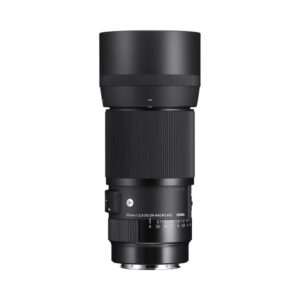
The detail lens nobody talks about: Sigma 105mm F2.8 DG DN Macro Art
Wedding albums are half moments and half objects. The rings. The mehendi patterns on the bride’s palms. The embroidery on the sherwani. The nameplate on the gift box. Clients expect those frames, and shooting them with a 24-70mm at minimum focus distance produces mediocre results.
A macro lens fixes this permanently. The 105mm f/2.8 gives you true 1:1 magnification, so a ring fills the frame with detail you cannot get any other way. And because it is 105mm at f/2.8, it doubles as a genuinely good portrait lens when you have room to work.
Most photographers here treat this as a third or fourth purchase. That is reasonable. But once it is in the bag, detail shots stop being a chore.
Prime versus zoom: what actually happens on the day
Photographers argue about this online. On a real wedding day the answer resolves itself.
Zooms win when you cannot move. Crowded stage, fixed vantage point, three photographers competing for the same angle, elderly relatives you cannot ask to shift. This describes a large share of Bangladeshi wedding coverage.
Primes win when the light dies. Once the sun goes and the hall lighting takes over, f/1.4 is not a luxury. It is the difference between a usable file and a mush of noise reduction.
The kit most working shooters here settle on:
- Body one: 24-70mm f/2.8 for ceremony and formals
- Body two: 85mm f/1.4 or 35mm f/1.4 depending on the venue
- In the bag: the other prime, plus a macro for details
That is three Sigma lenses and two bodies. It covers a full Bangladeshi wedding week without a gap.
What about APS-C shooters?
Plenty of photographers in Bangladesh are shooting weddings on Sony a6000-series or Fujifilm bodies, and that is a completely legitimate choice. The crop factor changes the maths.
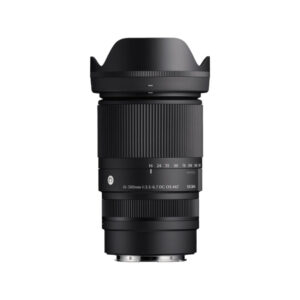
On APS-C, the Sigma 18-50mm F2.8 DC DN Contemporary gives you roughly a 27-75mm equivalent range in a lens small enough to forget you are carrying. It is arguably the best value lens Sigma has ever made and it handles ceremony coverage well.
Pair it with the Sigma 56mm F1.4 DC DN Contemporary, which behaves like an 85mm on full frame, and you have a two-lens wedding kit that costs a fraction of a full-frame setup and weighs about a third as much. For photographers building a business rather than a collection, that is a serious proposition.
Buying advice for Bangladesh specifically
Match the mount before anything else. Sigma’s DG DN lenses come in Sony E and L-mount. There is no adapter that makes this painless. Check your body first.
Buy from an authorised source. Grey-market lenses are common and cheaper, and they come with no local warranty. A wedding lens gets more shutter-hours in one season than a hobbyist lens gets in five years. When the focus motor goes, and eventually it does, you want it fixed here rather than shipped to Singapore.
Humidity is the real enemy. Dhaka’s monsoon season will grow fungus inside your glass if you leave gear in a cupboard. A dry cabinet costs less than one lens service. Buy one before you buy your third lens.
Prices move. Sigma lens prices in Bangladesh shift with import duty and exchange rates, so check current pricing with your dealer rather than trusting a figure you read in a blog from last year.
Build order, if you are starting from zero
- Sigma 24-70mm F2.8 DG DN II Art — covers the whole day, keeps you working
- Sigma 85mm F1.4 DG DN Art — the lens that makes clients recommend you
- Sigma 35mm F1.4 DG DN Art — takes the fear out of dark receptions
- Sigma 105mm F2.8 DG DN Macro Art — finishes the album
Four lenses. That is a complete professional wedding kit, and it is a build you can execute over two or three seasons rather than all at once.
Frequently asked questions
The Sigma 24-70mm F2.8 DG DN II Art is the strongest single choice, because it covers ceremony, formals and candids without a lens change. If you already have a zoom and want the shot that sells the album, the 85mm F1.4 DG DN Art is the next lens to buy.
Usually, on a modern body. You will sit around ISO 3200 to 6400 in a typical convention hall, which current full-frame sensors handle cleanly. For candlelit or heavily dimmed ceremonies, a f/1.4 prime gives you two extra stops and noticeably better files.
No. A Sony APS-C body with the Sigma 18-50mm F2.8 and the 56mm F1.4 covers a wedding properly. Full frame gives you better high-ISO performance and shallower depth of field, which matters most after dark.
Two, to start. A 24-70mm equivalent zoom and one fast prime. Everything after that is refinement rather than necessity.
At the apertures you shoot weddings at, yes. Sharpness stopped being the differentiator years ago. Autofocus behaviour and weight are the things worth comparing now.
Final thought
The lens does not shoot the wedding. You do. But the right lens removes the moments where you are fighting your gear instead of watching the room, and across a fourteen-hour day those moments add up to the difference between a good album and a great one.
Start with the zoom. Add the 85mm when the work justifies it. Everything else follows.