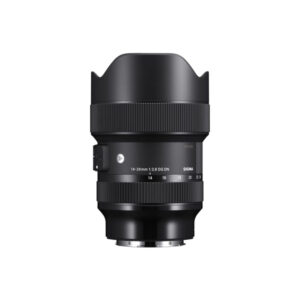
Sports photography is one of the most demanding areas of photography. Whether you are photographing a cricket match at a stadium, football on an outdoor field, school sports, athletics, motorsports, or indoor competitions, you often have only a fraction of a second to capture the decisive moment.
For sports and cricket photographers in Bangladesh, choosing the right lens is especially important. You may need to photograph a batsman from across the boundary, capture a bowler at the point of delivery, freeze a footballer running toward goal, or cover an entire sporting event from different positions.
This is where SIGMA telephoto and ultra-telephoto lenses become highly useful.
SIGMA offers several lenses designed for action photography, ranging from the fast 70-200mm F2.8 DG DN OS | Sports to ultra-telephoto options such as the 150-600mm F5-6.3 DG DN OS | Sports, 60-600mm F4.5-6.3 DG DN OS | Sports, and professional 300-600mm F4 DG OS | Sports.
If you are looking for genuine SIGMA lenses in Bangladesh, Hope Enterprises can help photographers, filmmakers and content creators choose equipment according to their camera system and shooting requirements.
This 2026 guide explains the best SIGMA lenses for sports and cricket photography, what focal length you need, why autofocus and stabilization matter, and which lens is most suitable for your budget and photography style.
Quick Answer: What Is the Best SIGMA Lens for Sports Photography?
There is no single lens that is best for every sports photographer.
Your ideal lens depends on how far you are from the action, available lighting, the sport you photograph, your camera system and how much equipment you want to carry.
Here is a quick comparison.
| SIGMA Lens | Best For | Maximum Reach | Key Advantage |
|---|---|---|---|
| SIGMA 70-200mm F2.8 DG DN OS Sports | Indoor & close-range sports | 200mm | Constant F2.8 aperture |
| SIGMA 100-400mm F5-6.3 DG DN OS Contemporary | Lightweight sports setup | 400mm | Portability |
| SIGMA 150-600mm F5-6.3 DG DN OS Sports | Cricket & outdoor sports | 600mm | Excellent reach |
| SIGMA 60-600mm F4.5-6.3 DG DN OS Sports | Multi-purpose sports coverage | 600mm | Huge 10x zoom range |
| SIGMA 300-600mm F4 DG OS Sports | Professional cricket & stadium sports | 600mm | Constant F4 + professional performance |
For most cricket photographers looking for long reach without moving into an extremely specialized professional setup, the 150-600mm and 60-600mm are particularly attractive.
For professional stadium photography where light-gathering ability, autofocus and image quality are priorities, the 300-600mm F4 DG OS | Sports is SIGMA’s flagship option.
Why Sports Photography Needs a Telephoto Lens
In many sports, photographers cannot stand close to the subject.
During a cricket match, for example, photographers may work near the boundary while the batsman, bowler or fielder is dozens of metres away.
A standard 24-70mm lens may capture the overall stadium environment, but it usually cannot provide enough reach for tight action photographs.
Telephoto lenses solve this problem.
A longer focal length allows you to:
- Fill the frame with distant players
- Capture facial expressions
- Photograph a batsman or bowler from the boundary
- Isolate athletes from distracting backgrounds
- Compress perspective
- Capture details from a safe distance
- Photograph celebrations and reactions
For outdoor cricket, football and field sports, focal lengths from approximately 200mm to 600mm are particularly useful.
What Makes a Good Lens for Cricket Photography?
Cricket photography has several unique requirements.
Long Focal Length
Cricket grounds are large. If you are photographing from outside the boundary, 300mm, 400mm, 500mm or 600mm can make a significant difference.
Fast Autofocus
Players move unpredictably. A fast autofocus system helps your camera follow the bowler, batsman, fielder or ball-related action.
Optical Stabilization
Long lenses magnify camera movement. Optical stabilization can help photographers maintain a more stable view and improve usability when shooting handheld or from a monopod.
Strong Image Quality
Sports photographs are frequently cropped for newspapers, websites and social media. A sharp lens gives you more flexibility when cropping.
Weather-Ready Construction
Cricket and football photographers often work outside for several hours. A robust lens design can be valuable in dusty environments or changing weather.
Suitable Aperture
A wider aperture allows more light to reach the sensor, which becomes important during evening matches, floodlit cricket and indoor sports.
1. SIGMA 300-600mm F4 DG OS | Sports – Best Professional Choice
For serious professional sports and cricket photography, the SIGMA 300-600mm F4 DG OS | Sports is one of the most advanced options in the current SIGMA lineup.
It covers the crucial 300mm to 600mm focal-length range while maintaining a constant F4 aperture throughout the zoom range.
SIGMA positions it as an ultra-telephoto zoom combining the convenience of a zoom lens with performance aimed at professional sports, action and wildlife photographers. It uses an HLA autofocus system and provides approximately 5.5 stops of optical stabilization at 600mm under SIGMA’s stated testing conditions.
Why It Is Excellent for Cricket
Imagine covering a cricket match from the boundary.
At 300mm, you can capture wider action involving multiple players.
Zoom toward 400-500mm for batsmen, bowlers or fielders.
At 600mm, you can create tight images from across the ground.
The major advantage is that you can change framing without switching lenses.
The constant F4 aperture is particularly valuable during evening matches or stadium events where available light may be limited.
Key Benefits
- 300-600mm focal range
- Constant F4 maximum aperture
- HLA autofocus
- Optical stabilization
- Internal zoom mechanism
- Professional Sports-series construction
- Suitable for action and wildlife
- Sony E-mount and L-Mount options
According to SIGMA’s current specifications, the lens weighs approximately 3.97-3.99kg depending on mount, so this is a specialized professional lens rather than a casual walk-around option.
Best for: Professional cricket, football, athletics, motorsports and major sporting events.
2. SIGMA 60-600mm F4.5-6.3 DG DN OS | Sports – Best All-in-One Sports Zoom
The SIGMA 60-600mm F4.5-6.3 DG DN OS | Sports is one of the most versatile choices for sports photographers.
Its biggest advantage is the enormous 60-600mm 10x zoom range.
SIGMA describes it as a full-frame mirrorless zoom capable of moving from standard telephoto framing to extreme 600mm reach without requiring a lens change. It features HLA autofocus and SIGMA’s OS2 stabilization system.
This versatility can be extremely useful during a cricket match.
At 60mm, you could photograph:
- Team celebrations
- Players near the boundary
- Award ceremonies
- Wider stadium scenes
At 300-600mm, you can photograph:
- Bowlers
- Batsmen
- Wicketkeepers
- Fielders
- Players on the opposite side of the ground
Why It Works for Event Coverage
Sports photographers cannot always reposition themselves quickly.
If a player suddenly approaches your side of the field while you are using a 600mm prime lens, they may be too close to frame.
With the 60-600mm, you can quickly zoom out.
That flexibility makes it particularly attractive for photographers covering an entire match rather than focusing on only one type of shot.
Key Benefits
- Massive 60-600mm range
- 10x zoom
- HLA autofocus
- Powerful optical stabilization
- Dual Action Zoom
- Sports-series construction
- Full-frame compatibility
- Sony E-mount and L-Mount
The trade-off is weight. SIGMA lists the lens at approximately 2.49kg, depending on mount.
Best for: Cricket photographers who want maximum framing flexibility from one lens.
3. SIGMA 150-600mm F5-6.3 DG DN OS | Sports – Best for Cricket Photography
For many photographers, the SIGMA 150-600mm F5-6.3 DG DN OS | Sports may provide the most practical balance between reach, performance and portability for cricket photography.
Its 150-600mm range covers the focal lengths most commonly required when photographing distant action.
SIGMA designed this lens specifically for full-frame mirrorless cameras and highlights fast, precise autofocus, optical stabilization, a focus limiter and construction intended for demanding telephoto shooting.
Why 150-600mm Is So Useful for Cricket
Cricket does not usually require a very wide focal length when your main objective is action photography.
Starting at 150mm still allows medium-distance shots, while 600mm gives you excellent reach.
This makes it ideal for photographing:
- Batsman playing a shot
- Bowler during delivery
- Wicketkeeper behind the stumps
- Close fielders
- Boundary catches
- Player expressions
- Celebrations after a wicket
Optical Stabilization
At 600mm, even small camera movements can become noticeable.
SIGMA’s current product information lists improved OS2 stabilization performance with current firmware, helping make long-range shooting more manageable.
Weight
The lens weighs around 2.1kg with its tripod socket, making it lighter than SIGMA’s 60-600mm Sports zoom and substantially lighter than the 300-600mm F4 professional lens.
For photographers working for several hours at a cricket ground, this difference can matter.
Best for: Cricket, football, wildlife and outdoor action photography where long reach is the priority.
4. SIGMA 70-200mm F2.8 DG DN OS | Sports – Best for Indoor & Low-Light Sports
Not every sporting event requires 600mm.
For indoor sports, close sideline photography and situations where photographers can position themselves relatively near athletes, the SIGMA 70-200mm F2.8 DG DN OS | Sports is an excellent option.
Its major advantage is the constant F2.8 aperture.
SIGMA’s current model uses dual HLA autofocus and offers optical stabilization rated up to 7.5 stops at the wide end under its stated test conditions.
Where 70-200mm Works Best
This range is particularly suitable for:
- Indoor sports
- Basketball
- Badminton
- Volleyball
- School competitions
- Football from the sideline
- Cricket players near the boundary
- Training sessions
- Press conferences
- Award ceremonies
Why F2.8 Matters
Sports photography frequently requires fast shutter speeds.
You may use 1/1000 sec, 1/1600 sec or even faster to freeze movement.
A wider F2.8 aperture helps collect more light, making it easier to maintain faster shutter speeds in poor lighting.
It can also create stronger subject-background separation.
SIGMA lists the Sony E-mount version at approximately 1,335g and the L-Mount version at approximately 1,345g.
Best for: Indoor sports, night events, close-range cricket and professional sideline photography.
5. SIGMA 100-400mm F5-6.3 DG DN OS | Contemporary – Best Lightweight Choice
Not every sports photographer wants to carry a 2kg or 4kg lens.
For users who prioritize portability, the SIGMA 100-400mm F5-6.3 DG DN OS | Contemporary offers a useful compromise.
The lens provides 100-400mm coverage in a body weighing around 1.14kg, depending on the mount. It includes optical stabilization, a focus limiter, an AFL button and a dual-action zoom mechanism.
Available versions include:
- Sony E-mount
- L-Mount
- FUJIFILM X Mount
For Fujifilm APS-C users, the narrower angle of view also makes the lens particularly useful for distant sports subjects.
Where It Works Best
The 100-400mm is suitable for:
- School cricket
- Club cricket
- Football
- Outdoor athletics
- Daytime sports
- Amateur competitions
- Travel photography
- Wildlife
Its 400mm maximum focal length does not provide as much reach as a 600mm lens, but the substantial weight saving can make it more comfortable for handheld shooting.
Best for: Enthusiasts and photographers who want telephoto reach without carrying a large Sports-series lens.
Best SIGMA Lens for Cricket: 150-600mm vs 60-600mm vs 300-600mm
These are three particularly strong choices for serious cricket photography.
| Feature | 150-600mm Sports | 60-600mm Sports | 300-600mm F4 Sports |
|---|---|---|---|
| Maximum Reach | 600mm | 600mm | 600mm |
| Wide End | 150mm | 60mm | 300mm |
| Maximum Aperture | F5-6.3 | F4.5-6.3 | Constant F4 |
| Approx. Weight | 2.1kg | 2.49kg | 3.97-3.99kg |
| Flexibility | Excellent | Exceptional | Professional specialized |
| Low-Light Ability | Good | Good | Excellent |
| Best User | Enthusiast/Pro | Event/Pro | Professional |
If portability and straightforward long-range coverage matter most, choose the 150-600mm.
If you want one lens that can move from relatively wide shots to 600mm, choose the 60-600mm.
If you need maximum professional performance with a constant F4 aperture and have the budget and support equipment for a large lens, consider the 300-600mm F4.
What Focal Length Is Best for Cricket Photography?
A useful general guide is:
70-200mm
Best when players are relatively close or when shooting training sessions, presentations and celebrations.
100-400mm
A strong portable option for smaller grounds and daylight cricket.
150-600mm
One of the most versatile ranges for boundary-side cricket photography.
300-600mm
Ideal for dedicated professional action coverage from greater distances.
Your camera’s sensor size also affects the field of view.
An APS-C camera provides a narrower field of view than a full-frame camera using the same focal length, which can effectively help when photographing distant subjects.
Recommended Camera Settings for Cricket Photography
A great lens still needs suitable camera settings.
For bright daytime cricket, try starting around:
Shutter Speed: 1/1000 sec to 1/2500 sec
Aperture: F4-F8 depending on lens and light
ISO: Auto ISO or adjust according to conditions
AF Mode: Continuous AF / AF-C
Drive Mode: High-speed continuous shooting
File Format: RAW or RAW + JPEG
For bowlers and batsmen, faster shutter speeds such as 1/1600 sec or 1/2000 sec can help freeze fast movement.
For creative panning shots, you can deliberately use slower shutter speeds.
Exact settings will always depend on light, camera model and the visual effect you want.
Monopod vs Handheld for Cricket Photography
Larger telephoto lenses can become tiring during long matches.
A monopod is often extremely useful for cricket photography because it supports the weight of the lens while allowing photographers to reposition quickly.
This is especially helpful with:
- 150-600mm
- 60-600mm
- 300-600mm F4
A lightweight 100-400mm may be easier to use handheld for extended periods.
The 70-200mm F2.8 can also be comfortably handheld by many photographers, depending on their shooting style.
Full-Frame vs APS-C for Sports Photography
Both formats can work well.
Full-Frame Advantages
- Better high-ISO performance on many camera systems
- Wider field of view
- Strong low-light capability
- Professional body options
APS-C Advantages
- Narrower field of view with the same focal length
- Helpful for distant subjects
- Often smaller camera systems
- Potentially more affordable entry point
For cricket photography, the additional perceived reach of an APS-C setup can be useful when photographing from far away.
Why Autofocus Matters More Than Extreme Aperture in Daytime Sports
It is easy to focus only on aperture specifications when comparing lenses.
However, sports photography also depends heavily on your camera and lens being able to track moving subjects consistently.
A sharp photograph at F6.3 is more useful than an out-of-focus photograph at F2.8.
For daylight cricket in Bangladesh, there is often sufficient light to work with telephoto zooms such as the 150-600mm or 60-600mm.
During evening or indoor events, however, wider-aperture options such as the 70-200mm F2.8 and 300-600mm F4 become more valuable.
Choosing the Right SIGMA Sports Lens in Bangladesh
Before buying, consider five things:
1. What Sport Do You Photograph?
Cricket and football generally need longer focal lengths than indoor sports.
2. How Close Can You Get?
If you have media access close to the field, 70-200mm may cover many situations.
From farther away, 400-600mm becomes much more useful.
3. Do You Shoot Day or Night?
Daytime photographers can comfortably consider variable-aperture telephoto zooms.
Night sports may benefit more from F2.8 or F4 lenses.
4. How Much Weight Can You Carry?
A professional 300-600mm setup is very different from a compact 100-400mm kit.
5. Is the Lens Compatible With Your Camera?
Always confirm the lens mount and camera compatibility before purchasing.
SIGMA’s current mirrorless sports lineup includes products for systems such as Sony E-mount and L-Mount, while the 100-400mm DG DN Contemporary also has a Fujifilm X version.
For product compatibility and current local availability, photographers in Bangladesh can consult Hope Enterprises before making a purchase.
SIGMA Sports Lens Price in Bangladesh
The SIGMA lens price in Bangladesh can vary according to the exact model, mount, stock availability, exchange rate and import conditions.
Professional ultra-telephoto lenses also vary considerably in price depending on their specifications.
Instead of relying on international pricing, buyers should check current Bangladesh availability before making a purchase.
For updated information about SIGMA telephoto lenses in Bangladesh, contact or visit Hope Enterprises.
This is especially important with specialized sports lenses because choosing the correct mount, focal length and camera combination is essential.
Frequently Asked Questions
The SIGMA 150-600mm F5-6.3 DG DN OS | Sports is an excellent all-round option for cricket because it combines 600mm reach with a more manageable size than larger professional alternatives. The 60-600mm provides greater zoom flexibility, while the 300-600mm F4 targets professional users.
Yes. A 600mm focal length provides excellent reach for photographing batsmen, bowlers and fielders from around the boundary on many cricket grounds.
Yes, especially when you are close to the players. It is also excellent for celebrations, training, award ceremonies and low-light sports photography.
Yes. Its 60-600mm zoom range allows photographers to cover both relatively close subjects and distant action without switching lenses. SIGMA specifically positions it for demanding applications including professional sports.
Stabilization does not freeze the athlete’s movement, but it helps reduce camera movement and gives a steadier view when working with long telephoto focal lengths.
Photographers looking for SIGMA imaging products, compatibility guidance and current local availability can check with Hope Enterprises in Bangladesh.
Final Thoughts
The best sports lens is not simply the lens with the longest focal length.
You need to consider reach, autofocus performance, aperture, stabilization, portability and your distance from the action.
For cricket photographers in Bangladesh, the SIGMA 150-600mm F5-6.3 DG DN OS | Sports offers an excellent balance of reach and practicality.
The SIGMA 60-600mm F4.5-6.3 DG DN OS | Sports is ideal when you want maximum zoom flexibility from one lens.
For professionals demanding a constant aperture and premium long-range performance, the SIGMA 300-600mm F4 DG OS | Sports represents a flagship solution.
The 70-200mm F2.8 DG DN OS | Sports remains an excellent choice for indoor, evening and close-range sports, while the 100-400mm F5-6.3 DG DN OS | Contemporary is a compelling lightweight option.
Whether you are photographing professional cricket, local tournaments, school sports, football, athletics or other fast-moving events, selecting the right lens will help you capture sharper, more engaging images at the decisive moment.
For genuine SIGMA lenses in Bangladesh, product information and help selecting a suitable lens for your camera and photography requirements, contact Hope Enterprises.