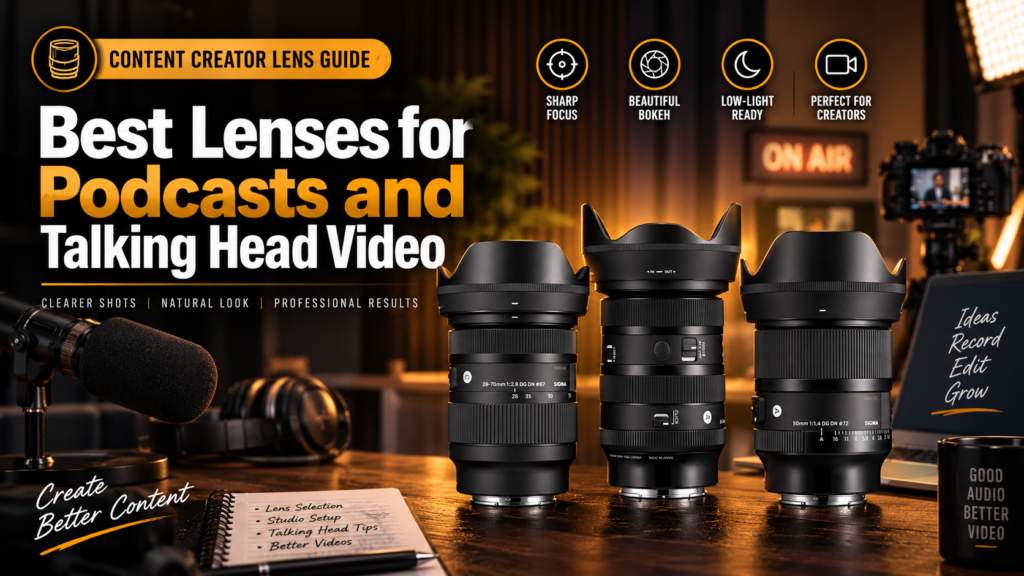
Choosing the best lenses for podcasts and talking head video can make a major difference in how professional your content looks. Your camera body matters, but the lens determines the field of view, framing, background separation, low-light performance, and much of the overall visual character of your video.
For podcasts, interviews, YouTube videos, online courses, corporate videos, and talking-head content, you usually need a lens that provides natural-looking facial proportions, enough room around the subject, dependable autofocus, and good performance under indoor lighting.
However, there is no single perfect focal length for every studio. A creator filming at a desk in a small room has different requirements from a two-person podcast recorded in a large professional studio.
In this guide, we explain the best focal lengths for podcasting, the difference between prime and zoom lenses, APS-C versus full-frame options, and some of the best SIGMA lenses for podcasts and talking head video.
What Makes a Good Lens for Podcasts and Talking Head Videos?
A good video lens needs more than simply high image quality.
For podcast and talking-head production, consider these factors:
- Suitable focal length
- Wide maximum aperture
- Reliable autofocus
- Natural-looking facial perspective
- Good background separation
- Low-light performance
- Manageable minimum focusing distance
- Quiet focusing
- Appropriate field of view for your room
- Compatibility with your camera mount
The ideal lens should allow you to position the camera at a comfortable distance while maintaining the composition you need.
For most creators, focal length and available room space should be the first considerations.
What Is the Best Focal Length for Talking Head Videos?
The most useful focal lengths generally fall between approximately 24mm and 85mm on full-frame cameras, depending on your shot and available space.
For APS-C cameras, remember that the smaller sensor provides a narrower field of view compared with full frame. For example, a 23mm APS-C lens gives a field of view similar to roughly 35mm on many APS-C systems.
Different focal lengths create different types of compositions.
16mm to 24mm: Best for Small Studios and Wide Shots
Wide-angle lenses are useful when your camera is positioned close to the presenter or when the room is small.
They are particularly suitable for:
- Small podcast studios
- Desk setups
- YouTube videos
- Vlogging
- Two-person shots
- Environmental talking-head videos
- Behind-the-scenes content
However, avoid placing an ultra-wide lens extremely close to a person’s face. Perspective depends primarily on camera-to-subject distance, and moving the camera too close can make facial features appear exaggerated.
Give yourself enough camera distance whenever possible.
28mm to 35mm: Excellent All-Round Talking Head Range
Around 28mm to 35mm on full frame is one of the most versatile ranges for video production.
It can show the presenter clearly while retaining enough of the background to establish the studio environment.
This range works particularly well for:
- YouTube creators
- Educational videos
- Podcast hosts
- Corporate interviews
- Product presenters
- Lifestyle content
A 35mm lens also allows you to show microphones, desks, practical lights, shelves, and other visual elements without making the subject too small.
50mm: Classic Talking Head Look
A 50mm lens on a full-frame camera provides a natural standard perspective when the camera is positioned appropriately.
It is excellent for medium and tighter talking-head shots.
A 50mm lens is particularly useful when you want:
- Strong subject emphasis
- Professional interviews
- Clean backgrounds
- Attractive bokeh
- Corporate talking-head videos
- Cinematic YouTube content
The disadvantage is that you need more room between the camera and subject than you would with a 24mm or 35mm lens.
85mm and Longer: Best for Tight Interview Shots
Longer lenses are excellent for close-up interview shots when there is enough space.
They can produce beautiful background separation and allow the camera to remain farther away from the presenter.
However, an 85mm lens is usually less practical in a small bedroom, home office, or compact podcast studio.
For larger production spaces, it can be excellent as a second-camera lens.
Prime vs Zoom Lenses for Podcasts
Both prime and zoom lenses can work extremely well for podcast production.
The right choice depends on how frequently your framing changes.
Prime Lenses
A prime lens has one fixed focal length.
Common options include:
- 16mm
- 23mm
- 30mm
- 35mm
- 50mm
- 85mm
Prime lenses frequently offer wide apertures such as F1.4, allowing more light into the camera and creating stronger background separation.
They are particularly useful for studios where the camera and host remain in fixed positions.
Advantages include:
- Wide apertures
- Excellent low-light performance
- Attractive background blur
- High optical quality
- Encourages consistent framing
The main limitation is that you cannot change composition simply by zooming.
Zoom Lenses
A zoom lens covers several focal lengths.
For example, an 18-50mm, 24-70mm, or 28-70mm lens can handle wide, medium, and tighter compositions without changing lenses.
Zoom lenses are particularly useful for professional studios producing:
- Podcasts
- Interviews
- Commercial videos
- YouTube content
- Corporate productions
- Multiple shooting formats
If your studio layout changes frequently, a quality F2.8 zoom may be more practical than several prime lenses.
Best SIGMA Lenses for Podcasts and Talking Head Video
SIGMA offers several lenses particularly well suited to modern video production.
The best option depends on your camera sensor, room size, desired composition, and camera mount.
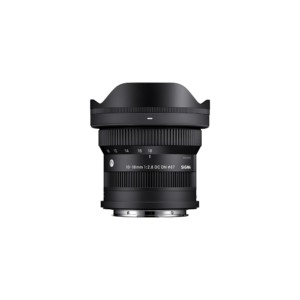
1. SIGMA 16mm F1.4 DC DN Contemporary — Best for Small Podcast Studios
The SIGMA 16mm F1.4 DC DN Contemporary is an APS-C lens designed for mirrorless systems.
Its wide field of view makes it particularly useful when the camera needs to remain close to the presenter.
The F1.4 maximum aperture also provides excellent flexibility when working with indoor lighting.
SIGMA currently lists versions for several systems, including Sony E, Fujifilm X, Canon RF, Nikon Z, L-Mount and Micro Four Thirds, although exact availability varies by market and mount.
Best For:
- Small podcast rooms
- YouTube studios
- Desk videos
- Vlogging
- Wide talking-head shots
- Two-person content
It is particularly useful if your studio simply does not provide enough distance to use a longer focal length.
2. SIGMA 23mm F1.4 DC DN Contemporary — Best APS-C Talking Head Prime
The SIGMA 23mm F1.4 DC DN Contemporary is one of the most balanced choices for APS-C talking-head production.
SIGMA describes it as providing an angle of view equivalent to approximately 35mm in full-frame terms, making it highly practical for everyday video and photography. It features an F1.4 maximum aperture and is currently offered for L-Mount, Canon RF, Fujifilm X and Sony E systems.
This focal length gives you enough background to establish the location without making the presenter appear distant.
Best For:
- Single-person podcasts
- YouTube talking heads
- Educational content
- Interviews
- Corporate videos
- Home studios
For many APS-C creators, 23mm is an excellent balance between a wide environmental shot and a tighter portrait composition.
3. SIGMA 30mm F1.4 DC DN Contemporary — Best for Tighter APS-C Shots
If you want a more focused composition, consider the SIGMA 30mm F1.4 DC DN Contemporary.
Its F1.4 aperture enables strong subject separation while remaining compact. SIGMA also highlights smooth autofocus performance suitable for videography. The lens is offered in multiple mirrorless mounts, including Sony E, Fujifilm X, Canon RF, Nikon Z and L-Mount.
It works particularly well when the camera can be positioned slightly farther from the presenter.
Best For:
- Medium talking-head compositions
- Professional interviews
- YouTube videos
- Educational content
- Creator studios
It can also be an excellent second-camera lens when a wider lens is being used for the master shot.
4. SIGMA 18-50mm F2.8 DC DN Contemporary — Best APS-C Zoom for Podcasts
Creators who want one flexible APS-C lens should strongly consider the SIGMA 18-50mm F2.8 DC DN Contemporary.
It combines an 18-50mm zoom range with a constant F2.8 aperture. SIGMA currently offers versions for Sony E, Fujifilm X, Canon RF and L-Mount.
That range allows the same camera to create:
- Wide podcast shots
- Medium talking-head frames
- Tight presenter shots
- Product shots
- Behind-the-scenes content
Instead of physically moving the tripod every time you need a different composition, you can adjust the focal length.
Best For:
- Podcast studios
- YouTube creators
- Interviews
- Small production teams
- Multi-purpose video studios
For creators who only want to purchase one APS-C lens, this is one of the most versatile options.
5. SIGMA 35mm F1.4 DG DN Art — Best Premium Full-Frame Talking Head Prime
For full-frame cameras, 35mm is an extremely useful focal length for talking-head video.
The SIGMA 35mm F1.4 DG DN Art combines an F1.4 aperture with a natural wide-standard perspective. SIGMA lists the current mirrorless version for Sony E and L-Mount and highlights its fast, quiet autofocus.
A 35mm composition can show both the presenter and enough of the surrounding environment to make the studio visually interesting.
Best For:
- Professional YouTube production
- Podcast hosts
- Documentary interviews
- Corporate videos
- Personal branding content
- Premium home studios
The F1.4 aperture can also create excellent separation between the presenter and background.
6. SIGMA 50mm F1.4 DG DN Art — Best for Cinematic Talking Heads
For a tighter and more cinematic composition, consider the SIGMA 50mm F1.4 DG DN Art.
It is a full-frame mirrorless Art-series prime available for Sony E and L-Mount. The lens combines an F1.4 aperture with high-speed autofocus and an 11-blade rounded diaphragm.
This focal length works beautifully when you have enough camera-to-subject distance.
Best For:
- Premium interviews
- Cinematic YouTube videos
- Corporate talking heads
- Online courses
- Personal branding videos
- Second-camera angles
For a two-camera podcast, you might use a 24-35mm lens for the master shot and a 50mm lens for an individual host close-up.
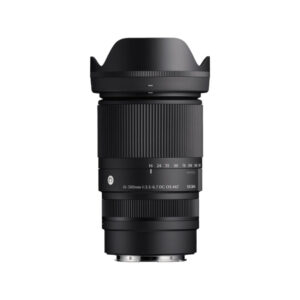
7. SIGMA 28-70mm F2.8 DG DN Contemporary — Best Compact Full-Frame Zoom
The SIGMA 28-70mm F2.8 DG DN Contemporary is another highly practical lens for video studios.
It covers wide-standard through short-telephoto focal lengths while maintaining an F2.8 aperture throughout the zoom range.
SIGMA lists it for Sony E and L-Mount, with a weight of approximately 470g, making it relatively manageable for a full-frame F2.8 standard zoom.
Best For:
- Professional podcast studios
- Interviews
- YouTube production
- Corporate videos
- Multi-camera setups
- Creators who need flexible framing
At 28mm, you can capture wider studio views. Around 35-50mm, you can produce natural talking-head framing, while 70mm provides a tighter shot.
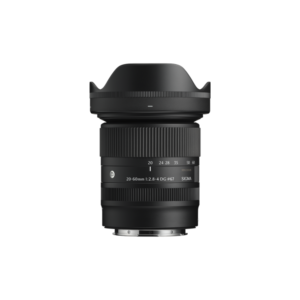
8. SIGMA 24-70mm F2.8 DG DN II Art — Best Professional Zoom
For professional production environments, the SIGMA 24-70mm F2.8 DG DN II Art offers even greater flexibility.
The current second-generation model covers 24-70mm with a constant F2.8 aperture and is available for Sony E and L-Mount. SIGMA says the updated model incorporates high-speed HLA autofocus and was designed to reduce focus breathing, a particularly useful consideration for filmmakers.
Best For:
- Commercial video production
- Professional podcasts
- Interviews
- Agencies
- Corporate production teams
- Multi-purpose studios
A professional studio that regularly changes between wide, medium, and tight compositions can benefit significantly from the flexibility of a 24-70mm zoom.
Best Lens Comparison for Podcast and Talking Head Video
| Lens | Format | Aperture | Best Use |
|---|---|---|---|
| SIGMA 16mm F1.4 DC DN | APS-C | F1.4 | Small studios & wide shots |
| SIGMA 23mm F1.4 DC DN | APS-C | F1.4 | Best general talking-head prime |
| SIGMA 30mm F1.4 DC DN | APS-C | F1.4 | Tighter talking-head shots |
| SIGMA 18-50mm F2.8 DC DN | APS-C | F2.8 | Flexible APS-C podcast setup |
| SIGMA 35mm F1.4 DG DN Art | Full Frame | F1.4 | Premium talking heads |
| SIGMA 50mm F1.4 DG DN Art | Full Frame | F1.4 | Cinematic close-ups |
| SIGMA 28-70mm F2.8 DG DN | Full Frame | F2.8 | Compact flexible setup |
| SIGMA 24-70mm F2.8 DG DN II Art | Full Frame | F2.8 | Professional production |
Best Lens for a One-Person Podcast
For a one-person podcast, a moderate wide or standard lens is usually the easiest choice.
On APS-C, a 23mm F1.4 gives a very useful field of view.
On full frame, a 35mm F1.4 provides an excellent balance between showing the presenter and maintaining some background context.
If you regularly change your set, use a zoom such as the 18-50mm F2.8 or 28-70mm F2.8.
Best Lens for a Two-Person Podcast
Two-person podcasts require a wider field of view.
An APS-C camera paired with the SIGMA 16mm F1.4 or 18-50mm F2.8 can work well when both hosts need to appear in one frame.
For full-frame cameras, a focal length around 24mm to 35mm is often easier to work with.
Be careful when using very wide lenses close to people. Positioning the camera farther back generally provides more natural perspective.
Best Lens for a Multi-Camera Podcast
A professional podcast setup often benefits from multiple focal lengths.
For example:
Camera A – Master Shot:
16-24mm APS-C equivalent setup or approximately 24-35mm full frame.
Camera B – Host Close-Up:
Around 30mm APS-C or 50mm full frame.
Camera C – Guest Close-Up:
Another standard or short-telephoto lens.
This creates visual variety and makes editing more engaging.
What Aperture Is Best for Talking Head Videos?
Extremely shallow depth of field can look attractive, but shooting everything at F1.4 is not always practical.
If the subject moves forward or backward, focus can become difficult to maintain.
For many talking-head videos, apertures around F2 to F4 provide an excellent balance between background separation and reliable focus.
For two people sitting at different distances, you may need to stop down further.
F1.4 lenses still provide an important advantage because they give you flexibility in low light and allow stronger background blur when required.
How Far Should the Camera Be From the Subject?
Camera distance depends on focal length, sensor size, and desired composition.
A wider lens allows the camera to remain closer, while longer focal lengths require more distance.
The goal should be to avoid placing the camera unnecessarily close to the face while maintaining the framing you want.
If you want a tight talking-head composition but have almost no room behind the camera, choose a moderately wide lens instead of forcing a 50mm or 85mm lens into the space.
Autofocus Matters for Podcast Video
Talking-head creators frequently work without a dedicated camera operator.
Reliable autofocus therefore becomes extremely valuable.
Modern cameras with face and eye detection can continuously follow the presenter, but the lens must also communicate and focus effectively with the camera system.
Quiet focusing is especially useful for video, although external podcast microphones normally reduce the chance of lens motor noise becoming noticeable.
Always confirm compatibility between your specific camera, mount, lens, autofocus modes, and firmware.
How to Choose the Right Lens for Your Podcast Studio
Before buying a lens, answer these questions:
- Is your camera full frame, APS-C, or another sensor format?
- How large is your recording room?
- How far can the camera be positioned from the host?
- Are you recording one person or multiple people?
- Do you want the background visible or heavily blurred?
- Do you need one fixed composition or several focal lengths?
- Does your camera use Sony E, Canon RF, Fujifilm X, Nikon Z, L-Mount, or another mount?
- Will you use the same lens for photography?
- Do you regularly record in low-light environments?
- Will you operate the camera yourself?
These questions are more important than simply buying the most expensive lens available.
Frequently Asked Questions
What is the best lens for podcasts?
For most podcasts, a lens between approximately 24mm and 50mm full-frame equivalent is highly practical. Wider lenses work well for multi-person or small-room setups, while longer focal lengths are better for tighter individual shots.
Is a 35mm lens good for talking head videos?
Yes. A 35mm lens on a full-frame camera is one of the most versatile options for talking-head video because it provides a natural-looking composition while showing enough of the surrounding environment.
Is 50mm good for podcast video?
Yes, particularly for one-person close-ups and secondary camera angles. However, a 50mm lens requires more camera-to-subject distance than a wider lens.
Is 16mm too wide for a podcast?
Not necessarily. On APS-C cameras, 16mm can be extremely useful in small studios or when recording two people. Avoid positioning the camera unnecessarily close to faces.
Which SIGMA lens is best for APS-C podcast video?
The SIGMA 23mm F1.4 DC DN Contemporary is an excellent prime option, while the SIGMA 18-50mm F2.8 DC DN Contemporary is ideal for creators who want zoom flexibility.
Which SIGMA lens is best for full-frame talking head video?
The SIGMA 35mm F1.4 DG DN Art is an excellent premium prime, while the SIGMA 28-70mm F2.8 DG DN Contemporary and 24-70mm F2.8 DG DN II Art provide greater flexibility.
Should I use F1.4 for podcast videos?
You can, but you do not always need to. F1.4 creates stronger background blur and helps in low light, but apertures around F2-F4 can provide more dependable focus for presenters who move while speaking.
Final Verdict
The best lenses for podcasts and talking head video depend on your camera format, recording space, number of presenters, and preferred visual style.
For compact APS-C studios, the SIGMA 16mm F1.4 DC DN Contemporary provides a useful wide field of view. For a natural everyday talking-head composition, the SIGMA 23mm F1.4 DC DN Contemporary is one of the most balanced options.
Creators who want one versatile APS-C lens should consider the SIGMA 18-50mm F2.8 DC DN Contemporary.
For full-frame systems, the SIGMA 35mm F1.4 DG DN Art provides an excellent premium talking-head look, while the SIGMA 50mm F1.4 DG DN Art works beautifully for cinematic individual close-ups.
Professional studios that require maximum flexibility can choose an F2.8 standard zoom such as the SIGMA 28-70mm F2.8 DG DN Contemporary or SIGMA 24-70mm F2.8 DG DN II Art.
Ultimately, do not choose a podcast lens based on specifications alone. Measure your studio, determine your camera-to-subject distance, identify the shots you need, check your camera mount, and then choose the focal length that gives you the most natural and professional composition.
With the right lens, lighting, camera position, and audio setup, even a simple podcast studio can achieve a polished, professional visual style.