Sony’s APS-C bodies are everywhere in Bangladesh, and for good reason. An a6400 or a6700 gives you fast autofocus, excellent video, and a body small enough to carry all day, at a price that leaves budget for glass.
The problem has always been the glass. Sony’s own APS-C lens range is thin, and the good ones are expensive enough that people start wondering whether they should have gone full frame in the first place.
This is the gap Sigma filled, and filled so completely that for several focal lengths there is no serious competition. Here is which Sigma lens for Sony APS-C actually deserves your money, ranked by how often you will use it.
Understanding the crop factor first
Everything below assumes you know this, but it is worth thirty seconds.
Sony APS-C has a 1.5x crop factor. A 30mm lens on your a6400 frames like a 45mm lens on a full-frame body. A 56mm frames like an 85mm.
The aperture does not change. f/1.4 lets in exactly as much light on APS-C as on full frame. What changes is depth of field, which behaves roughly like f/2.1 on full frame at the same framing. This is why full frame produces more blur at equivalent settings, and why it does not matter as much as forum arguments suggest.
Sigma’s DC DN line is built specifically for this format. Not adapted, not cropped down. Designed for it. That is why they are so much smaller than the full-frame equivalents.
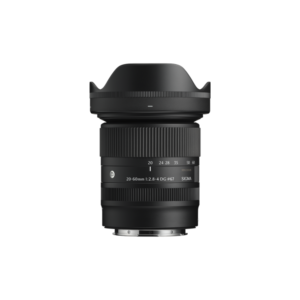
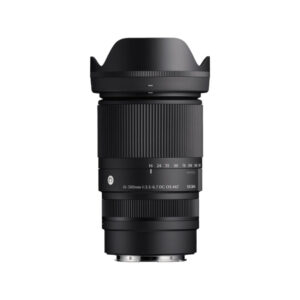
1. Sigma 18-50mm F2.8 DC DN Contemporary — buy this first
If you own one Sigma lens for your Sony APS-C body, own this one.
A constant f/2.8 standard zoom, covering a 27-75mm equivalent range, weighing 290g and costing a fraction of any first-party alternative. Nothing else in the E-mount APS-C world does this.
What it replaces: your kit lens, permanently.
What it enables: indoor shooting without panic, portraits with real background separation, and a close-focus distance of 12cm that turns it into a semi-macro for food and product work.
Its one flaw: no optical stabilisation. On an a6700 with IBIS, irrelevant. On an a6400, it means handheld video needs support.
For most people in Bangladesh shooting a mix of events, travel, family and content, this lens lives on the camera and rarely comes off. That is the highest compliment a lens can get.
2. Sigma 30mm F1.4 DC DN Contemporary — the cheapest way to good photos
This lens has been around a while and it has not been beaten.
At roughly 45mm equivalent, it sits at the focal length that most closely matches how people see. Not wide, not tight. It is the lens you use when you do not know what you are going to shoot.
f/1.4 on APS-C is genuinely fast. You can shoot a dim restaurant at ISO 800. You can separate a subject from a cluttered Dhaka street background. And it weighs 265g.
Use it for: street, everyday carry, low-light candids, environmental portraits, learning.
Its weakness: autofocus is a stepping motor and is not as fast as the newer designs. For a running child or a bird, look elsewhere. For everything else, it is fine.
Buy it if: you want the biggest jump in image quality for the least money. There is no better answer to that question in E-mount.
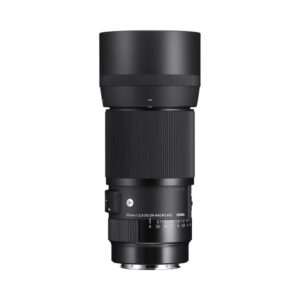
3. Sigma 56mm F1.4 DC DN Contemporary — the portrait lens
84mm equivalent at f/1.4, in a lens that weighs 280g.
This is the lens that makes people think you upgraded your camera. Skin renders cleanly, backgrounds turn to colour, and the compression at 84mm equivalent flatters faces the way an 85mm always has.
It is also absurdly sharp. Wide open at f/1.4 it out-resolves lenses costing three times as much. Sigma made an unusual decision with this lens and prioritised optical performance over size, then somehow kept it small anyway.
Use it for: portraits, headshots, tight candids, weddings on APS-C, product detail with a blurred background.
Its weakness: on APS-C, 84mm equivalent means you stand well back. In a small room you run out of space. It is not a general-purpose lens.
Buy it if: you shoot people. If you shoot people for money, buy it now.
4. Sigma 16mm F1.4 DC DN Contemporary — wide and fast
24mm equivalent at f/1.4. This is the lens for anyone who thinks their photos are too tight.
Two audiences buy this. Astrophotographers, because f/1.4 at 24mm equivalent with good coma control is exactly what you need for a night sky, and Bangladesh has dark-sky spots within reach if you drive. And vloggers, because 24mm equivalent handheld at arm’s length frames your face plus the scene behind you, which is the whole point of a vlog.
It also does architecture and interiors well, which matters if you shoot real estate or events in tight venues.
Its weakness: it is the heaviest of the DC DN trio at 405g, and it takes 67mm filters, which is a chunkier front element than the others.
Buy it if: you shoot wide, shoot at night, or talk to a camera.
5. Sigma 23mm F1.4 DC DN Contemporary — the newer option
Sigma’s more recent APS-C prime, at roughly 35mm equivalent.
35mm equivalent is the classic documentary focal length. Wide enough for context, tight enough that faces do not distort. Between the 16mm and the 30mm, this fills the gap that street photographers care about most.
The autofocus motor is newer and faster than the 30mm’s, which is a real advantage on an a6700 with subject-recognition AF. If you are choosing between the 30mm and the 23mm today and you shoot moving subjects, the 23mm is the better-engineered lens.
Buy it if: 30mm feels too tight and 16mm feels too wide, or if you shoot street and events.
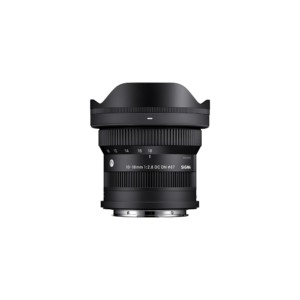
6. Sigma 10-18mm F2.8 DC DN Contemporary — the ultra-wide
15-27mm equivalent at a constant f/2.8, in 260g.
This is a specialist lens and you will know if you need it. Interiors, architecture, landscapes with foreground drama, and vlogging where you want more than 24mm gives you.
Most people do not need an ultra-wide. The people who do need it use it constantly.
Building your kit: three realistic paths
Path A — The one-lens setup
Sigma 18-50mm F2.8. Done. Covers wide to portrait at a usable aperture. If you are not sure what you want to shoot yet, this is the answer.
Path B — The two-prime setup
Sigma 30mm F1.4 + Sigma 56mm F1.4. Roughly 45mm and 84mm equivalent. Total weight 545g. This is a complete portrait and street kit, and it costs less than most single first-party zooms. Slower to work with, but the files are better.
Path C — The working kit
Sigma 18-50mm F2.8 + Sigma 56mm F1.4. Zoom for coverage, prime for the shots that matter. This is what most people shooting paid work on APS-C in Bangladesh end up carrying.
Sigma versus Sony’s own APS-C lenses
Worth being direct about this.
Sony’s APS-C primes (the 20mm f/2.8, 35mm f/1.8) are competent and stabilised, and the 35mm has better autofocus than Sigma’s older 30mm. But they are slower, and the price gap is not small.
Sony’s 16-55mm f/2.8 G is a genuinely excellent lens and it is stabilised. It also weighs 494g and costs substantially more than the Sigma 18-50mm. Whether that gap buys you anything meaningful depends on whether you need OSS.
The honest summary: Sony makes good APS-C lenses. Sigma makes lenses that are 90% as good for roughly half the money, in smaller bodies. For most people, including most working photographers, that trade is correct.
Buying advice for Bangladesh
Mount: all of these come in Sony E. Confirm you are buying the E-mount version, not L-mount or X-mount. They look similar in listings and they do not adapt.
Authorised versus grey market: grey imports are common and cheaper. They come with no local warranty. Stepping motors and aperture units do eventually fail, and a lens you cannot get serviced locally is a lens you replace instead of repair. The price gap is usually smaller than one repair.
Humidity: this is not optional advice. Dhaka and Chattogram humidity grows fungus inside lens elements, and fungus is a permanent write-off. A dry cabinet with silica costs less than any lens on this list.
Filters: the 18-50mm, 30mm and 56mm all take 55mm filters. That is a small, cheap thing that saves you money, because one UV filter and one ND filter cover your whole kit.
Prices: Sigma lens prices in Bangladesh move with import duty and the exchange rate. Check with your dealer for current figures.
Frequently asked questions.
The Sigma 18-50mm F2.8 DC DN Contemporary. It replaces the kit lens entirely, gives you two extra stops at the long end, and is small enough that it does not change the character of the camera. If you shoot portraits, add the 56mm F1.4.
Yes. A Sigma 35mm F1.4 DG DN mounts and works on an a6400, framing like a 52mm. It is larger, heavier and more expensive than the DC DN equivalents, and you gain nothing unless you plan to move to full frame later.
Yes. Sigma’s DC DN and DG DN lines are used professionally worldwide. Buy from an authorised source so warranty support exists, and they will outlast the camera body.
The 23mm has newer, faster autofocus and a wider 35mm-equivalent view. The 30mm is cheaper and tighter. For street and events, take the 23mm. For portraits and general use on a budget, the 30mm.
Yes. All current DC DN lenses support Sony’s Eye AF and subject recognition. The newer designs track faster than the older ones.